Does anybody remember when Donald Trump announced huge tariffs on everybody (with the “interesting” exceptions of Russia, Belarus, and North Korea) and got into a huge game of tariff one-upmanship with China, resulting in cartoonishly high tariff levels by both countries? I certainly do, but from all appearances the US stock market has completely forgotten about all of that.
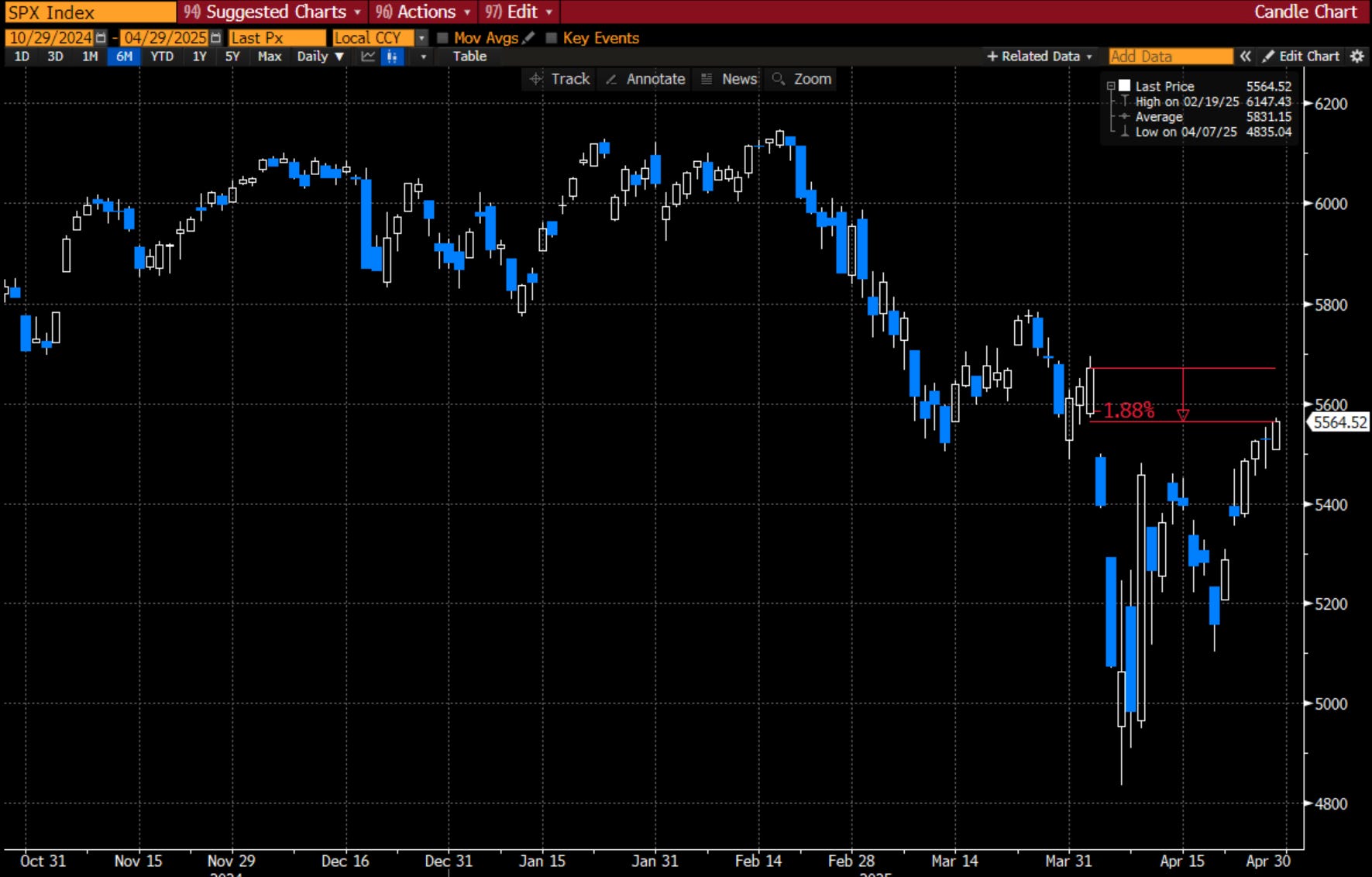
After a volatile month the S&P 500 Index sits less than 2% lower than it did immediately prior to Trump’s “Liberation Day” announcement. After a large initial bounce from the news that the “reciprocal” tariffs on most nations had been paused for 90 days to allow time for negotiations, it has continued to rally over the past two weeks or so on nothing more than vague rumors and official Whitehouse lies. As I have watched this play out, I have been at turns baffled, amused, and enraged by the conscious myopia of investors and traders.
Any news that negotiations to deescalate the trade war with China or forestall the imposition of steep tariffs on the EU, Japan, and South Korea were progressing positively would be a legitimate reason for optimism. The problem is that the Trump Administration is NOT close to agreements with Japan, the EU, or with anybody else, for that matter.
Japanese and EU trade delegations have said they don't know what the US wants and neither do Trump's negotiators. I believe this to be true with 100% confidence. How could they? Vietnam already tried this, by offering zero tariffs on US goods, immediately before "Liberation Day". Trump’s fraudulent trade czar Peter Navarro said on CNBC that the Trump Administration gave Vietnam a flat “No” to that offer.
Moreover, what can really be negotiated when the guy with the final say for the US side does not understand anything and is highly likely to renege on any agreement?
It's absurd.
The absurdity knob has been dialed up over the past few days, as Trump made outlandish claims in the long sit-down interview with Time released on Friday.
Your trade adviser, Peter Navarro, says 90 deals in 90 days is possible. We're now 13 days into the point from when you lifted the reciprocal, the discounted reciprocal tariffs. There's zero deals so far. Why is that?
No, there’s many deals.
When are they going to be announced?
You have to understand, I'm dealing with all the companies, very friendly countries. We're meeting with China. We're doing fine with everybody. But ultimately, I've made all the deals.
Not one has been announced yet. When are you going to announce them?
I’ve made 200 deals.
You’ve made 200 deals?
100%.
Again, this is absurd and is not happening. Per an Associated Press story on Friday.
Beyond the idea that Trump plans to keep some level of tariffs in place, the world finance ministers and corporate executives who gathered this past week in Washington for the International Monetary Fund conference said in private discussions that the Trump administration was providing no real clarity on its goals for substantive talks (emphasis added).
“There’s not a coherent strategy at the moment on what the tariffs are supposed to achieve,” said Josh Lipsky, senior director of the GeoEconomics Center at The Atlantic Council. “My conversations with the ministers and governors this week at the IMF meetings have been they don’t understand completely what the White House wants, nor who they should be negotiating with.” (emphasis added)
Trump’s claims specific to negotiations with China are even more ridiculous and humiliating. He continues to maintain that negotiations are ongoing, while China's Foreign Minister is doing his best William Wallace impression at the BRICS conference: rallying emerging market nations to fight the US “bully” and portraying China as the global champion of free trade.
This would all be supremely amusing if it weren’t such a serious matter and there weren’t multiple economic time bombs, primed and counting down. The fantasy world that the Trump Administration is trying to create (and that the stock market seems to find soothing) is about to implode.
Bomb 1: The Reverse Tsunami of Goods
A "reverse Tsunami" of goods from China is about to occur on the West Coast of the United States. Container volumes from China to the ports of Long Beach and LA will be down 44% year-over-year in the first week of May.
The week after that, the volumes will fall another 30% or so from the week before.
Volumes on the smaller China to US East Coast trade routes are also collapsing in real time. Drewry Shipping Consultants, one of the most reputable firms that track global shipping markets, reported a cancellation rate of 41% (an all-time record for a major trade route) for upcoming sailings on those routes.
This reduction in trade will cause an economic shockwave, primarily starting in the Los Angeles area and spreading across the country over the following weeks, as trucks aren't filled with consumer goods, and nobody is needed to unload them at distribution centers.
We'll then see layoffs really accelerate and, within a matter of a few weeks, there will be noticeably less abundance of selection on the shelves of stores like Walmart and Target. I don't know what the dollar stores will sell. Small businesses that rely on imports from China and have few, if any, alternative sources of supply will quickly go out of business.
Bomb 2: The 90 Day “Pause” is Already Nearly One Third Gone.
Given all of the above, I think people should be a lot more conscious that time is ticking away quickly on the 90-day pause that Trump announced on April 9th. I believe that if the Trump Administration decides to execute a “climb down” of these tariffs, both Japan and the EU may be amenable to allowing Trump some sort of face saving “victory”. Lord knows the man loves to take a victory lap, even after he has received a shellacking.
But that is impossible if there are no actual negotiations ongoing and if one of the sides in the negotiation is unwilling (or unable) to make any kind of deal. My fear is that because tariffs have been an enthusiasm of Trump’s for 40+ years, he has made being “proven right” on his bizarre and wrong-headed ideas non-negotiable.
Back to the Time interview (I apologize for the length of this excerpt, but I think it is really necessary to understand the level of delusion Trump is operating under):
Well, I mean, the question is, how can CEOs make long-term plans and investments if our tariff policy can change from day to day and still remains so uncertain?
How can they make long-term investments? I'll turn it around. How can they make long-term investments if our country is losing $2 trillion a year on trade?
Will you consider giving exemptions—
No wait, just so you understand. How can we sustain and how is it sustainable that our country lost almost $2 trillion on trade in Biden years, in this last year. That's not—when you talk about a company. I had the head of Walmart yesterday, right in that seat. I had the head of Walmart. I had the head of Home Depot and the head of Target in my office. And I'll tell you what they think, they think what I'm doing is exactly right.
Well, the CEOs of small businesses are saying they may not be able to last another two months with the current regime in place. Will you consider giving small businesses an exemption similar to what you've given to Big Tech?
I’d have to look at the individual business.
Would you consider it?
Our country is going to be very rich in not a long period of time. I've been doing this for three months, and if you look at the kind of numbers that we're taking in and the jobs, and if you look at, more importantly, the companies, the chip companies, the car companies, the Apple. $500 billion. Apple is investing $500 billion in building plants. They never invested in this country.
Small businesses are worried that you’re treating the Apples of the world better than you’re treating them.
No, I’m treating small businesses—small businesses will be a bigger beneficiary of what I'm doing than the large businesses. But everybody's going to benefit.
If we still have high tariffs, whether it's 20% or 30% or 50%, on foreign imports a year from now, will you consider that a victory?
Total victory.
Why so?
Because the country will be making a fortune. Look, that's what China did to us. They charge us 100%. If you look at India—India charges 100-150%. If you look at Brazil, if you look at many, many countries, they charge—that's how they survive. That's how they got rich. Now, zero would be easy. Oh, zero would be easy, but zero, you wouldn't have any companies coming in. They're coming in because they don't want to pay the tariffs. Remember this, there are no tariffs, if they make their product here. There are no tariffs, if they make their product here. There are no tariffs. This is a tremendous success. You just don't know it yet, but this is a tremendous success what’s happening. We're taking in billions and billions of dollars, money that we never took in before. We're also, very importantly, because of that, because of the money we're taking in, those companies are going to come back and they're going to make their product here. They're going to go back into North Carolina and start making furniture again. They've already started. In Mexico, many car plants that were under construction have stopped. They're all coming into this country. We're gonna, you're gonna see car plants going at a level that you've never seen before.
I don’t have the time or inclination to correct or debunk every error and lie in Trump’s responses. Suffice it to say that nothing he said is remotely accurate in the real world.
The real issue isn’t the rotten foundation of his policy positions but rather the simple question: does this sound like a guy ready to give up on tariffs?
Bomb 3: There are still MORE tariffs in incubation.
Unless Trump does a total about face on the whole idea of tariffs (which, again, seems quite unlikely), another wave of sector-specific tariffs is in the offing. Almost nobody is talking about them and their potential impacts.
If you want to read about these tariffs in deep detail, I recommend The Clues to Trump's Future Tariffs on Joseph Politano’s Apricitas Economics blog. I summarized the main points (including using the Politano’s original wording, in some cases) in an email to my partners the other day:
Key Points:
Trump administration still appears to be planning additional sectoral tariffs, in addition to the blanket country-level tariffs announced on "Liberation Day".
These tariffs would be 25% and would be enacted under the National Security provisions of the 1962 Trade Expansion Act.
A sham regulatory finding in support of these tariffs is essentially guaranteed.
Would impact $670B in imports (2024), at a 25% tariff rate on all of them, it would boost overall tariff rate by 5 percentage points.
Trump has repeatedly said they are looking at the "whole electronics supply chain" for additional tariff actions. This crucially includes semiconductors, and potentially semiconductor capital equipment.
Obvious problem: most chips are not imported on their own, but as components of finished or semifinished manufactured goods. Which leaves two options:
Narrower but more complex option—take every imported electronic good, have companies certify the value of the semiconductors embedded within, and assess a tariff only on those semiconductors. This would, however, incentivize companies to produce the entire device or product outside the US.
Simpler but more destructive option—simply assess a large tariff on all semiconductors entering the US and key electronics entering the US. The aggregate costs to consumers and businesses would be much higher, but it would mitigate the problem of tariffs simply pushing companies to manufacture electronics entirely outside the US.
When Trump exempted phones, computers, and TVs from most of the tariffs, he also added exemptions for semiconductor manufacturing equipment. It would have been logical to assume that exception would remain permanent.
But the administration recently posted documentation confirming the worst—they’re looking into tariffs on chipmaking equipment.
Tariffs on raw materials (lumber and copper particularly) will hit industry hard, especially construction.
Lumber tariffs are very bad for Construction, especially homebuilding.
Canada supplies most of the raw and processed wood imported into the United States.
Particularly painful for the US construction sector, the largest domestic consumer of wood, and will stack on top of the pain already caused to the industry by steel tariffs.
Copper tariffs would hurt Construction and Electronics and Electrical manufacturing.
Tariffs on copper mostly target three trading partners: Chile, Canada, and Peru.
The copper trade from Chile & Peru was previously considered so important that it helped them become two of only three South American nations where the US has a formal free trade agreement.
Would negatively impact construction the most, since the sector is also the largest consumer of copper, but they will also make it more difficult for electronic & electrical manufacturing to expand in the US by driving up their raw material costs.
I would love to wrap this up with something wise or optimistic, but right now, I’ve got nothing.